How to Install an EV Charger in Your Housing Society: A Practical Guide for Owners and Tenants
Buying an EV is the easy part. For millions of Indians living in flats, the real question is: “Where will I charge it?”
In a housing society you deal with shared parking, a Resident Welfare Association (RWA), a common electrical network and, if you rent, a landlord too. The good news is that this is far more solvable today than it was a couple of years ago. Here is how to do it, step by step.
What the rules say
The Ministry of Power’s Guidelines for Installation and Operation of Electric Vehicle Charging Infrastructure (September 2024) support private charging in group housing societies. In simple terms, a resident can set up a private charger at their own designated parking space, and the electricity distribution company should supply power through the existing meter or a separate sub-meter.
Keep in mind:
- State rules differ. Some states have their own circulars on approval timelines and EV tariffs. Check with your local DISCOM.
- Society bye-laws still matter. Most societies expect a written request and safety details.
- Location matters. Open or stilt parking is usually simpler than a basement, where fire-safety expectations can be stricter.
This is general information, not legal advice.
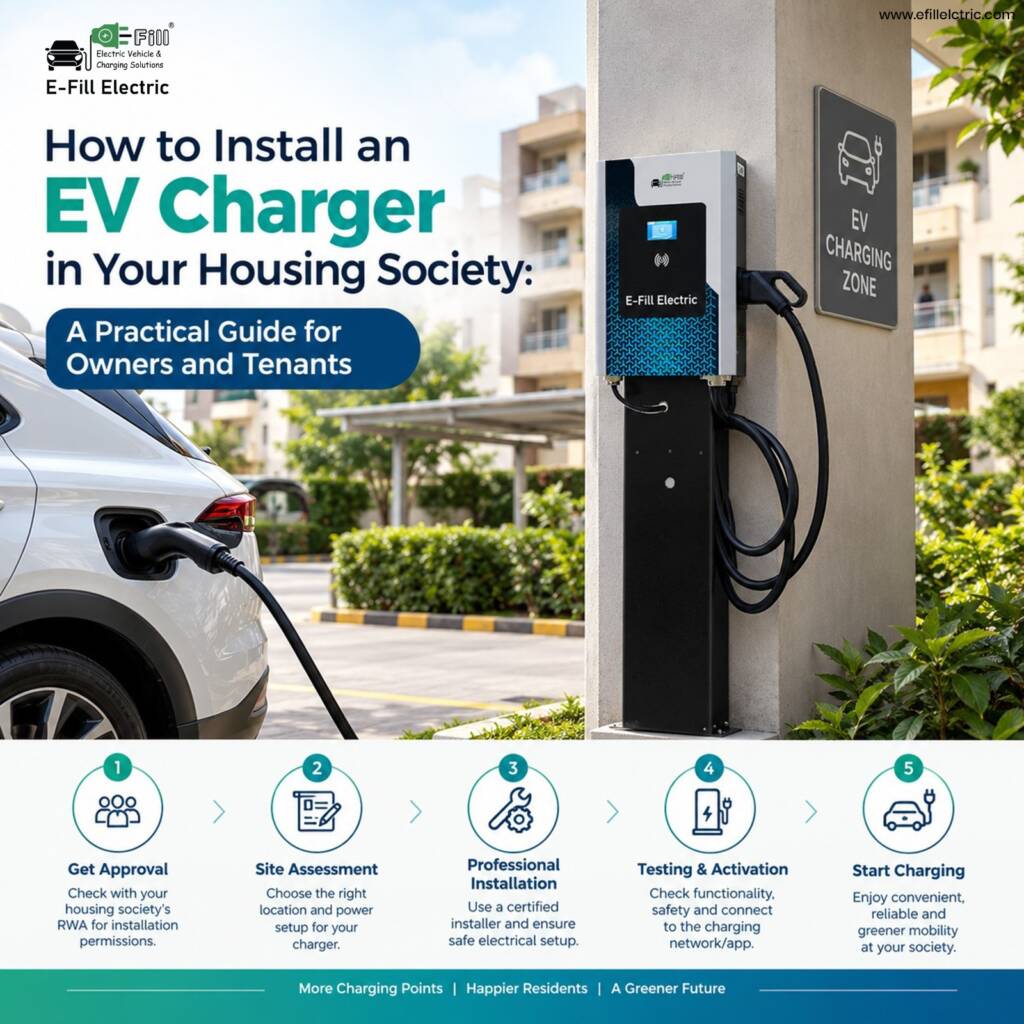
Step-by-step: installing a charger in your society
1. Check your parking slot and get a site survey
A private charger works best when the slot is yours and close to a power source. Before buying anything, have a qualified installer check the distance to the power source, your sanctioned load, the condition of wiring and earthing, and how the cable can be routed safely. This one step prevents most expensive surprises.
2. Choose the right charger
Charger type | Typical supply | Best suited for |
Lower-power AC (around 3.3 kW) | Single-phase, 16A | Two-wheelers, three-wheelers, small EVs, overnight charging |
Higher-power AC (around 7.4 kW) | Single-phase, 32A | Electric cars that need faster overnight charging |
Your vehicle’s onboard charger decides how much power it can accept, so check the manual first. A bigger charger is not better if your vehicle cannot use it.
3. Write to your RWA
A clear written request gets approved faster than a verbal ask. Include your flat and slot number, the charger details, the installation plan, safety measures (dedicated circuit, protection devices, earthing), your billing method, and a note that a qualified installer will do the work at your cost. Keep the tone cooperative. Most RWA worries, such as overload, fire risk and who pays for power, are answered by a proper survey, a dedicated circuit and your own meter.
4. Decide how electricity is measured
- Existing flat meter: simplest, charging units add to your normal bill.
- Separate sub-meter or EV meter: cleaner tracking, may unlock an EV tariff where available, and avoids billing arguments with the society.
5. Installation and testing
A good installation includes a dedicated circuit (not shared with geysers or ACs), correctly rated copper cable, proper protection devices (MCB or RCBO, surge protection where suitable), tested earthing, dust- and water-protected mounting, and a final test and handover. Always use a licensed electrician or trained installer.
6. Keep it maintained
Check the cable and connector for wear, keep the area dry, and stop charging and get it inspected if you see repeated tripping or unusual heating.
Quick safety checklist
☐ Dedicated circuit with correctly rated protection
☐ Earthing tested
☐ No extension boards or multi-plugs in the charging path
☐ Charger mounted away from water splash
☐ Cable routed safely
☐ Written approval from the society (and landlord, if you rent) saved with you
If you are a tenant
- Get your landlord’s permission in writing.
- Pick a wall-mounted charger that can be removed and refitted at your next home.
- Use a separate meter or sub-meter so your bill is clearly yours.
- Agree on restoration of drill marks or wiring changes when you move out.
No dedicated parking slot?
Ask your RWA to set up shared, metered charging points, explore a community bay shared by interested residents, and use workplace or public charging in the meantime. Start the conversation early. Even a few EV owners are enough for most societies to plan charging properly instead of living with ad hoc extension cords.
Why choose E-Fill Electric
E-Fill Electric builds EV charging solutions designed for Indian conditions: voltage variations, dust, heat and shared parking. Our chargers are safe, dependable and simple to use, with features such as anti-theft protection for the charging gun, a real concern in open and shared parking areas. Whether you are an owner, a tenant or an RWA planning shared charging, our team can guide you from site survey to final installation.
Ready to set up charging at your home or society?
With the right plan, the right paperwork and the right charger, home charging in a society is entirely achievable. Talk to the E-Fill Electric team about a site survey and a charger that fits your parking, vehicle and society. Visit efillelectric.com to get started.